For the tenth year running, Vision Group, together with the Embassy of the Netherlands, KLM Airlines, dfcu Bank and Koudijs Animal Nutrition, is running the Best Farmers Competition. The 2025 competition runs from April to November, with the awards in December. Every week, Vision Group platforms are publishing profi les of the farmers. Winners will walk away with sh150m and a fully paid-for trip to the Netherlands.
Stephen Chemonges, 57, is one of the known farmers in Tutungon village because of his commitment to Irish potato farming.
For over 20 years, Chemonges has risen from modest beginnings to a respected producer of quality seed potatoes in the wider Sebei sub-region from his home in Tutungon cell, Kapchorwa district.
His farming journey is proof that passion, experience and practical knowledge can turn a simple farm into a dependable source of wealth and inspiration. “Commercial farmers remain poor because they grow crops they do not understand,” Chemonges explains, while walking through his well-organised 35-acre farm. Of this, 20 acres are dedicated to Irish potatoes.
He also grows maize on four acres, eucalyptus on two acres, pine on one acre and keeps dairy cattle on eight acres. Despite limited formal education, Chemonges is a respected farmer, employer and trainer.
“What distinguishes Chemonges is not only the size of his farm, but the trust he has earned through the quality of his produce, his mentorship of young farmers, and the discipline with which he operates,” Josuha Ewal, a resident and farmer, says.
Humble beginnings
Chemonges’s journey into commercial farming began in 2000, when he purchased one-and-a-half acres of land. Using the proceeds from the initial garden, he bought other pieces of land where he grew onions and cabbages.
He kept buying more land until he made the 35 acres he owns today. At the start, sourcing quality Irish potato seed was one of his biggest challenges.

“I used to buy seed from Kampala, but most of it would arrive diseased or rotten, leading to huge losses,” Chemonges recalls.
In 2018, he faced a devastating setback when he stored 500 tonnes of Irish potatoes in a poorly ventilated store. The stock rot, resulting in a major financial loss. This misfortune attracted the attention of an agricultural support organisation in the region.
The team visited the farm, interviewed Chemonges about his farming practices, challenges and the source of seed.
Impressed by his resilience, they offered to support him under one condition; he had to contribute to the construction of a modern greenhouse and an improved storage facility.
The organisation provided seedlings worth sh1m and co-financed the construction of a greenhouse.
Chemonges catered for the floor and the organisation handled the rest of the structure.
In early 2019, he planted 495kg of improved Irish potato seedlings on virgin land. From one acre, he harvested over 200 bags, each weighing 100kg.
Three months later, he hit another milestone. After following proper agronomic practices and benefiting from fair weather, Chemonges harvested 210 bags, nearly three times the regional average of 80 bags per acre.
At a farm gate price of sh70,000 per bag, this harvest made him a millionaire.
He credits his success to the improved seed he received from the International Fertiliser Development Centre, which boosted his yields.
Chemonges explains that the soils in his village are similar to those in Kabale, adistrict popular for Irish potato production in Uganda.
This similarity in soil quality makes Tutungon village ideal for growing Irish potatoes, giving him an edge in production. After experiencing a breakthrough in yields, Chemonges realised that a good harvest alone does not guarantee success.
“I faced challenges with market access, storing excess produce and post-harvest losses,” he explains.
The Irish potato project
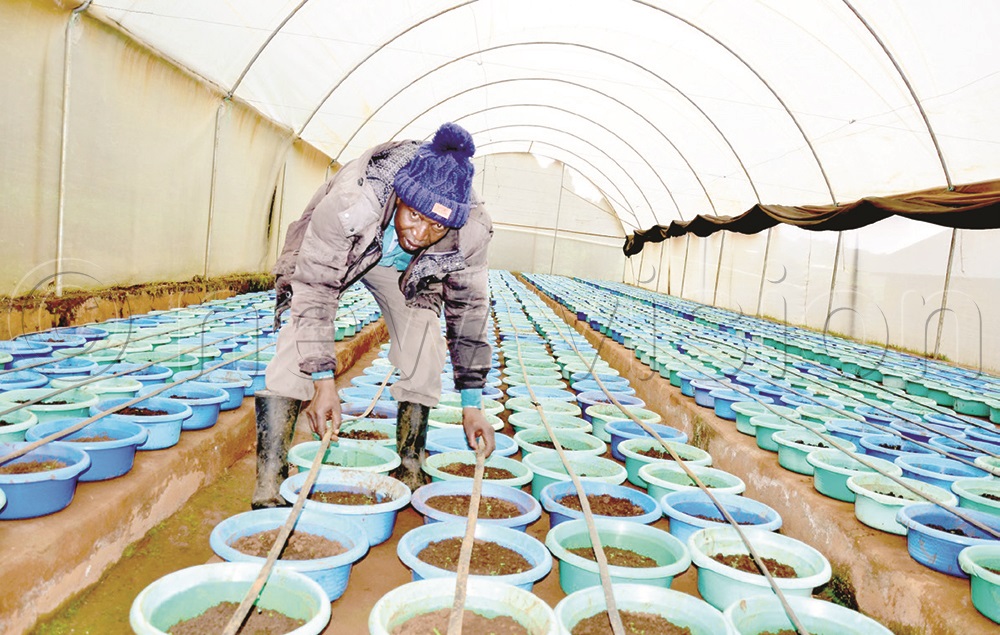
One of the best innovations is growing high-value Irish potato varieties in a greenhouse.
“I selected the best varietieslike Markies, Taurus and Panamera and grew them in greenhouses where I can control the temperature, moisture and pests. This method gives me clean, uniform and disease-free tubers,” he explains.
In the greenhouse, Chemonges uses baskets filled with sterilised soil. To disinfect the soil, he uses a machine that applies direct heat or fire to kill pests, fungal spores and bacteria.
This soil sterilisation technique is effective in eliminating pathogens without using chemicals. Combined with lime and bio-pesticides, it ensures the soil is disease-free.
“It takes 18 months between production and the realisation of seed,” he explains.
Market
The market for Chemonges’s produce is both in Uganda and Kenya.
“My main markets are in Kapchorwa, Bukwo and Mbale. Traders from Kenya also come to pick produce from the farm,” he says.
Some buyers also make orders for delivery to urban markets like Nakawa and Nakasero in Kampala.
Storage
To support continuous supply, Chemonges built a store with a capacity of up to 300 tonnes.
“Potatoes can stay fresh in the store for more than three months at room temperature,” he explains.
The facility is raised above the ground, with wooden shelves, proper ventilation and a thatched roof to regulate the temperature. This prevents rot, sprouting and pest infestation.
Every two months, Chemonges inspects the tubers for firmness, eye development and skin quality, selecting only the best for seed.
Best agronomic practices
“A good seed must have at least one strong eye,” Chemonges says.
He selects vigorous, disease-free tubers from the store and cuts them carefully, allowing time for healing before planting.
By using only the best materials, he ensures healthy and high-yielding plants. Chemonges chooses land with well-drained, sandy loam soils.
He first clears the bush and ploughs the land twice with a two-week break between.
Dairy farming enterprise
Dairy farming is another major income-generating activity on Chemonges’s farm.
He started the enterprise in the early 2000s with one exotic cow that yielded 25 litres daily.
“That cow gave me hope. I later bought three more using money from Irish potatoes,” Chemonges says.
Patricia Chebet, his wife, says the farm now boasts of 28 cows, with 15 producing milk.
“We get 270 litres daily and sell each at sh1,000,” she explains.
“We use cow dung as organic manure in our banana plantation and maize gardens, which has improved soil fertility. The business also keeps our children in good schools and helps us meet our household needs.”
Chemonges adds: “Dairy farming has taught us discipline, hard work and has created employment for at least three youths.”
Trees and maize
To reduce the reliance on Irish potatoes, Chemonges diversifi ed into tree and maize farming around 2008.
He planted maize on four acres and eucalyptus on two, with pine on one acre.
Farm expenses
Most of the income generated is reinvested to keep the farm running efficiently.
Chemonges spends between sh5m and sh6m monthly on salaries.
“I pay myself sh1.5m and my wife receives sh500,000,” he reveals.
Challenges
His greatest challenge, Chemonges says, is fake farm inputs, especially seeds and chemicals, which often result in poor yields and loss of income.
He also struggles to find skilled labour, which affects timely planting and proper crop management. Unpredictable weather has increased operational costs.
“We used to depend on rainwater, but now, without irrigation, a good harvest is not guaranteed,” Chemonges adds.
Achievements
Chemonges says his farm has grown and now attracts visitors from all walks of life.
“With proceeds from the farm, I have bought land and constructed houses,” he explains.
Margaret Cheptoris says the establishment of an Irish potato seed multiplication centre is a major breakthrough, providing quality seeds and boosting productivity for Chemonges and all Irish potato farmers in Sebei sub-region.
Plans
Chemonges plans to transform his farm into a fully-fledged model farm within the next five years.
He also aims to promote farming for export by equipping more farmers in the community with knowledge on commercial agriculture and modern practices.
“Kenya is close by and attracts many foreigners, so there is potential for regional trade if we grow the right crops and meet export standards,” Chemonges says.
Adding value to the maize is another plan, where he will mill into flour.
“With good packaging, the maize flour will fetch high prices,” he says.
Irrigation, management
Chemonges believes irrigation is a necessity in farming.
“I invested sh7m to bring piped water from the main source to my farm,” he explains.
Most of the expenditure went into acquiring sprinklers and installing irrigation lines across his fields.
“We already had piped water in the area, so I didn’t have to spend much on water access. My focus was mainly on the distribution system within the farm,” Chemonges adds.
Management practices
Chemonges’s wife, Patricia Chebet, takes the lead in managing farm records.
“She keeps track of all expenses and income. She is also the head supervisor of our workforce,” he says.
Chebet handles most of the procurement duties, while their children help with farm activities during holidays.
Labour force
Chemonges’s farm is a source of livelihood for many.
“I employ five full-time workers, including an assistant veterinary officer,” he says.
Chemonges hires 10 casual labourers, each earning sh10,000 per day.