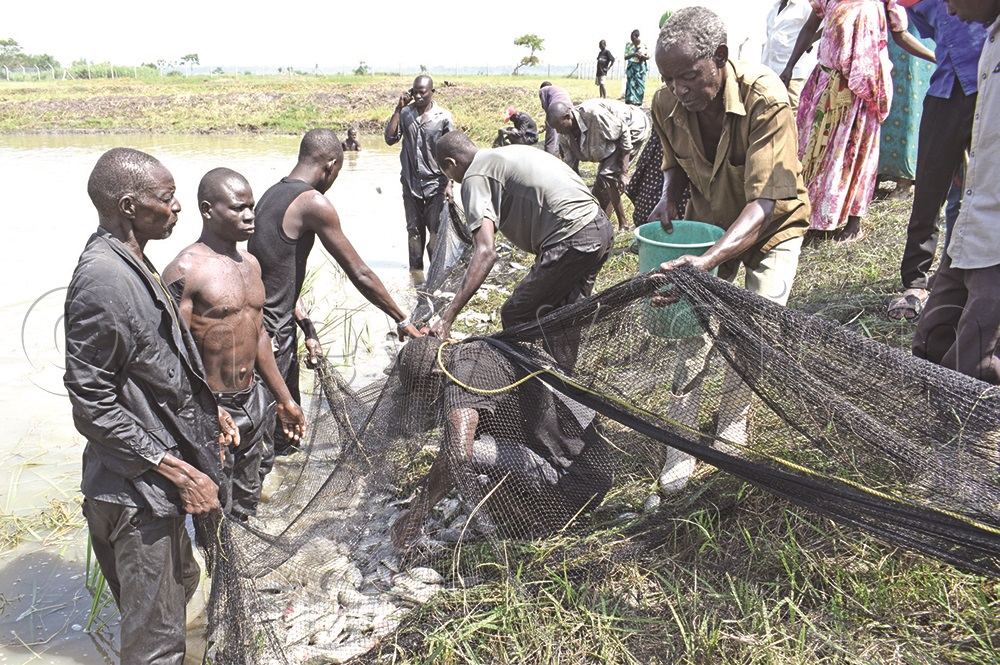
In eastern Uganda, communities that once faced eviction for farming in wetlands have found a new lease on life through sustainable fish farming and vegetable production.
The Limoto Tukume Obutonde Community Fish Farming Group has not only restored the degraded wetland, but also improved the livelihoods of its members.
Eight years ago, conservation experts at the National Environment Management Authority (NEMA) said the nation’s wetland cover had reduced from 13% to 8%.
The experts blamed the degradation on the illegal practice of reclaiming the wetland for paddy rice farms.
Thus, farmers were evicted forcibly from the wetland. To offer farmers alternatives, President Yoweri Museveni, in his remarks at Kalaki Primary School in Pallisa district at the time, said: “People should not be forced to leave the wetlands, but instead they should be sensitised on why they ought to voluntarily leave or use them for activities like fi sh farming, which does not affect the wetland.”
Local communities, such as Limoto Tukume Obutonde Community Fish Farming Group in Pallisa, heeded his call. Siragi Gesoni, 43, the farmer group chairperson recollects that when they quit growing rice eight years ago, the Government, in partnership with Global Climate Fund (GCF) and United Nations Development Programme (UNDP), came to their aid.
Their efforts yielded the project dubbed ‘Building Resilient Communities’, which is improving the lives of 72 individual farmers.
Ahmed Samuka, the natural resources officer of Pallisa, said the affected farmers ventured into fi sh farming and growing vegetables.
Consequently, 99% of the previously degraded Limoto wetland ecosystems in Pallisa is now fast regenerating. Limoto wetland ecosystem surrounds Lake Kyoga in Pallisa.
Fish farming
To roll out fish farming, the farmers were organised in groups and fish ponds set up for them.
The enterprise, boasting of eight fish ponds, sits on an acre. Engineer Patrick Okotel, the manager water for production, mid-eastern region at the environment ministry, said among the preliminary tasks his office was assigned was establishing community fish ponds infrastructure.
“Together with the relevant district technical team, we are tasked with helping stock the ponds and supervise the project,” Okotel said.
In a co-funding arrangement, Grace Salamuka, 40, a treasurer of the farmer group, said they raised sh66m.
“The Government provided sh23m as a development partner, that would help in procuring fingerlings stock and feeds, among others,” she noted.
The group’s maiden fish stock was 42,000 fingerlings, comprising tilapia and catfish species. The harvest was in August 2022, after a gestation period of eight months.
She said second harvest season came in August 2023, after the group stocked 36,000 catfish fingerlings.
“Challenges of feeds then would feature prominently as the entire stock gained modest weight,” she noted.
Salamuka said the returns totalled sh37m. The group would share sh17m saving sh20m, that later enabled them kick-start their third production cycle.
According Gesoni, there is cause for celebration at the launch of the third fish enterprise harvest last week, as the farmer group is close to attaining the breaking-even-point in the business. A technical evaluation of the fish stock shows that one weighs 500g to 2.5kg.
“We anticipate a net turnover of not less than sh80m from sales of about 28,000 mature catfish, going by the lowest farm-gate price of sh3000, for a 500g cat fish,” Gesoni said.
Thus far, sh43m out of the total sales proceeds have been shared as dividends among the farmer community, while sh23m has been deposited on the farmers’ account.
What makes the third harvest season to be different from the previous ones is discovery of cheap alternative fish feeds.
According to Okotel, during a bench-marking exercise, the farmers learnt of cost-effective means to feed the fish.
“Discovering that chicken offals serve as nutritious feeds for fish has been a break-through, as expenses the farmer group regularly committed to feeds dropped by 98%, boosting the farmer community profit margin,” Okotel noted.
He said in the first two production cycles, the group bought 40kg of fish feeds at sh450,000. On the other hand, with the offals, they spend sh20,000 for 40kg.
The feeds are accessed from outlets in Kampala and Mukono districts, where a kilogramme of offals goes for sh500. For sustainability of the fish farming project, experts have long proposed the setting up of a poultry enterprise.
“The essence in this is further cutting down fish feeds expenses,” Okotel observed.
“When chicken droppings are thrown in the pond, as they decompose, they produce maggots that are a high protein nutritious food stuff for the fish,” explained Samuka, who is also a fisheries expert.
Challenges
The chairperson of the fish farmer group said among the critical challenges the group faces is the lack of a refrigerated truck.
“When harvest season sets in, the local market cannot absorb the entire stock, hence the harvest is done in phases. We need a truck to ferry our produce to distant market points,” said Gesoni.
Small scale irrigation
Apart from fish farming, other farmers ventured into growing vegetables. This required water for all-year production.
Okotel said small scale irrigation schemes, complete with solar energy systems capable of pumping water to irrigate fields during the dry spell, have since been established.
What group members say
Henry Mugaalo, 36, noted that dividends from the earlier production cycle have helped him reduce the level of poverty at his household.
He has since used the money (dividends) to start a poultry farm.
“I have since bought chicken and turkeys, whose number has since grown to 300 birds. I am no longer perennially broke, since I can afford essential household needs,” he noted.
Siragi Gesoni, the group chairperson, said he has used the dividends to start a vibrant poultry enterprise. Grace Salamuka, the group’s treasurer, a mother of six, said she is no longer a burden to her husband.
She added that dividends have helped her roll out a string of enterprises, ranging from local chicken, turkeys and a second hand cloth stall in the market.
Background
The group chairperson, Siragi Gesoni, said they used to encroach on the wetland ecosystem at the height of dry spells.
“We were confronted with severe effects of long dry spells and the small arable land parcels we possessed were unproductive. For years, the land was ploughed without fallowing, which took a heavy toll on its fertility.
“The only short-lived alternative livelihood at the time was to ravage the wetland where the soils were still fertile,” Gesoni revealed.
However, after dozen seasons, a particular wetland land that had been cleared would lose its fertility.
“The next thing would be expounding on frontiers of encroachment,” he said.
The state of affairs changed with the introduction of alternative economic activities, like fish farming and horticulture.
“We have since appreciated that the fish farming enterprise is more profitable than paddy rice farming. Our request to the President is to allot us more fish ponds,” he said.
LEAD PHOTO CAPTION: Fish farming has turned fortunes for farmers in Paliisa district following their decision to abandon rice growing in wetlands. (Photo by Moses Nampala)