For the tenth year running, Vision Group, together with the Embassy of the Netherlands, KLM Airlines, dfcu Bank and Koudjis Animal Nutrition is running the Best Farmers Competition.
The 2025 competition runs from April to November, with the awards in December. Every week, Vision Group platforms will publish profiles of the farmers. Winners will walk away with sh150m and a fully paid-for tip to the Netherlands.
In February, 2014, after he quit growing sugarcane, Alfred Ojok, 33, a resident of Lalar village, Paminyai sub-county in Nwoya district, started planting coffee.
He says he had realised that coffee is a long term investment. Between August and September 2014, he dug coffee holes and in 2015, he planted 450 clonal robusta seedlings on one acre. The seedlings cost him sh135,00 altogether.
“The highest amount I ever got from selling sugarcane was sh800,000 in 2012, which I had planted on one acre in a swampy area in Unyama sub-county. So, in 2017, when I got sh3m from selling coffee, I could not believe it. I had never held such an amount in my life,” he says Learning that coffee is a long term investment that could eradicate poverty, led Ojok to invest heavily in it.
“I paid my O’level and A’level school fees using money I got from selling sugarcane. This had put my health at risk. Luckily enough, I started hearing about coffee growing and decided to give it a try after researching about the returns one makes from coffee,” Ojok adds.
Since 2015 to date, he has 25 acres of coffee, three acres of fruits including avocado, jackfruit, oranges, soursop and two acres of cocoa. He gets sh1.8m from them annually. He has since named his farm Hasting Coffee.

It has improved the standard of living of those surrounding him, who usually go to do casual labour there.
How he started
Ojok’s journey to becoming a renowned coffee farmer started in 2015, when he failed to join university. He had dreamt of becoming a computer programmer after studying physics, chemistry and mathematics at A’level.
He thought one could not excel in life without going to university.
“When I failed to join university, I decided to make good use of the 60 acres that my father gave to us his four sons,” he says.
Ojok did not have any knowledge on how to plant or maintain coffee.
“I was afraid to start it on a large scale thinking I might fail since I lacked knowledge on the best agricultural practices. But I decided to start with one acre after the farmer I had bought the seedlings from taught me how to plant coffee,” Ojok says.
Between March and July 2014, he planted seven acres of pine to control soil erosion and to generate income.
Coffee projects
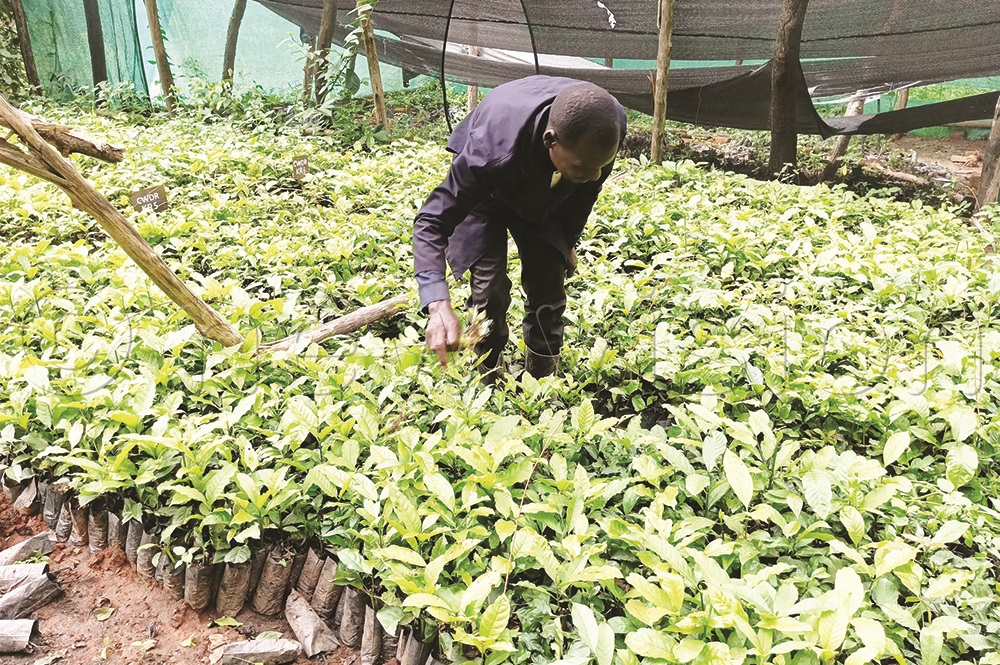
Ojok’s Hasting Coffee centre is a registered business with Uganda National Bureau of Standards that offers training to over 20 farmer groups in Nwoya, propagates coffee seedlings and it employs 20 casual labourers, four of whom are women.
“Coffee is changing my life and it is my desire to empower the community with skills to grow the crop so that they can also benefit from it the way I am. The profit I get from here is what I use to facilitate my movement to train farmer groups in Nwoya without expecting anything from them,” he says.
Ojok’s mission is to turn a village without any commercial commodity into a centre of excellence in coffee growing in northern Uganda.
“There is no harm in sharing knowledge. Remember the saying that a candle loses nothing if it lights other candles,” he says.
Clonal robusta coffee seedlings go for sh2,000. Currently, he has been contracted by the agriculture ministry’s coffee department to supply seedlings to farmers in Nwoya district.
Value addition
In February 2025, Ojok decided to add value to his coffee by hulling four sacks of kiboko, each weighing 90kg.
His earnings were so promising that he was inspired to hull 14 more sacks the following month (March) and earned sh24m.

He told New Vision that a kilo of unhulled coffee beans goes for sh6,000, while the hulled one is sh15,000.
He was charged sh200 per kilo of coffee hulled. Between March and July 2014, he planted seven acres of pine trees for the purpose of controlling soil erosion and to generate income even though he has not yet sold any. This year, he started cocoa growing on two acres.
Achievements
Using proceeds from coffee, Ojok has bought a motorcycle which helps him in movement, wedded his wife and constructed a residential house in Gulu city.
He says his children are studying in high-profile schools.
His casual labourers have embraced coffee growing which is changing their lives.
He reinvests most of the returns in the farm. Officially, he earns his monthly salary of sh500,000 and his wife earns 250,000.
Challenges
Climatic conditions such as dry spells have remained Ojok’s biggest challenge, which he hopes with irrigation, he will have solved the problem.
Interference by middlemen who tend to set the prices at which coffee should be sold to them is also another challenge he was facing until he and others formed a co-operative to sell in bulk and jointly bargain for the prices. Theft still remains one of his biggest problems.
He says, thieves always steal his bananas from the farm.
“I empowered my neighbours through teaching them the benefit of growing bananas and living harmoniously in the community. I gave them free banana suckers to start planting rather than stealing from my farm. This has reduced the rate of theft.”
Ojok has seven acres of bananas which he planted in 2024 and 2025.
Best agronomic practices
To get good yields, Ojok uses organic fertilisers consisting of cow dung, goat manure and coffee husks, which he mixes with soil.
The seven acres of pine trees also helps in controlling soil erosion hence reducing flooding.
Ojok planted albizia trees which help reduce the effects of drought and floods.
He intercrops coffee with beans, soya, ground-nuts to provide food to the family.
He also mulches and weeds the farm.
To get good yields, Ojok uses organic manure consisting of cow dung, goat manure and coffee husk which he mixes with soil.
Family involvement
Ojok’s family are involved in the process of picking coffee and that is where they also earn from, except he and his wife who are paid monthly — sh500,000 and sh250,000 respectively.
Plan
After getting high returns in value addition, Ojok plans to purchase a huller and a roasting machine so that he helps other farmers he is empowering to get good profits and reduce the cost of hulling for them.
He plans to work hand-in-hand with his community members to make coffee seedlings which he would sell at a very low price to ensure that they do it as one way of poverty eradication.
“After empowering the community, I want to inspire the youth, especially those who dropped out of school and those who have lost hope in life that with coffee, you can still live your best life.”
Ojok dreams of selling coffee on the international market and promoting the ‘Acholi coffee brand’
What others say about the enterprise
Denis Onen, 50
I have worked with Ojok for five years as a casual labourer. The money I earn is what I use to pay my children’s school fees in Gulu city and feed my family. We can now afford to have a balanced diet. Right now, I have two acres of coffee which I planted after buying seedlings from him.
Doreen Akello, 63
Ojok is not mean with his knowledge. I like how he has ensured that all of us who live in a neighbourhood live a better life. At times when times become hard, I reach out to him seeking financial support.
Both my two boys and I work here and with the money we get, we constructed a two-bedroomed house. I have planted coffee on 1.5 acres, with the hope of planting more. At Ojok’s farm, I prepare nursery beds and pick coffee, among others.
Christine Atim, 35, single mother of two
I have worked with Ojok for three years. I have learnt the benefit of coffee from him, which I never knew. It is us who pick the coffee once it ripens and when he is selling it, you hear a big amount being mentioned like sh20m and you wonder. I am now in the process of saving money to buy land so that I can plant coffee and I live a better life.