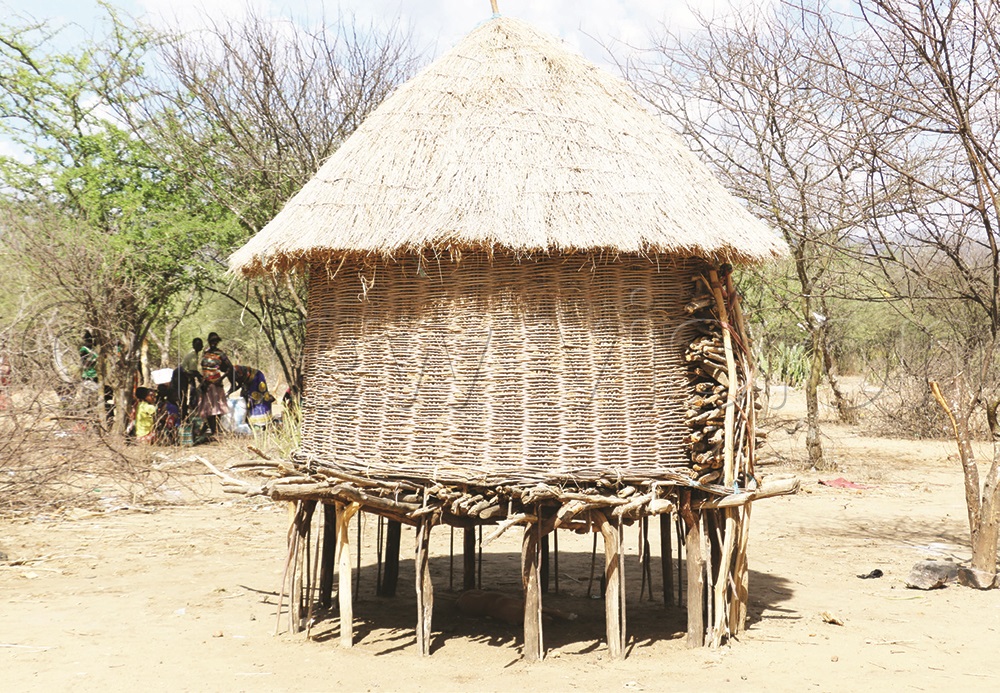
The granary is a common structure in almost every rural homestead in northern and eastern Uganda, particularly in the Teso and Karamoja sub-regions.
Among small-scale farmers, it is one of the most prized possessions, serving as the ultimate grain storage facility.
“I grew up seeing my parents store their food in granaries,” Joseph Ekocu, 54, a farmer in Aloet, near Soroti town, says.
In times when many farmers suffer significant losses due to poorly constructed storage spaces, the traditional granary remains a reliable solution.
Described as one of the most remarkable indigenous African food storage inventions, the granary holds both practical and cultural importance.
“At home, especially during times of scarcity, the granary was the most precious structure in the compound. An empty granary was not only an embarrassment to the wife, but also to the husband,” Mary Amongin, 63, from Ngora district, says.
Granaries resemble large, baskets, constructed using reeds, bamboo, mud mixed with dung and roofed with thatch. Most are circular and raised above the ground using strong poles, which helps protect the contents from moisture and rodents.
The thatched roof insulates against extreme heat and rain, ensuring that stored crops remain dry and mould-free. Their storage capacity typically ranges from 300kg to 500kg.
These structures are especially useful for preserving cereals such as maize, millet and sorghum, as well as pulses like beans though its construction differs by region Granaries are still a common sight in eastern, northern, northwestern, and parts of western Uganda. In the central region, a granary is called ekyaagi.
In Teso, it is referred to as edula. Granaries also provide a climate-resilient food storage option, especially in areas affected by flooding.
Why granaries still matter
One of the key reasons granaries are raised is to adapt to local environmental conditions, especially in fl ood-prone areas of eastern and northern Uganda, where heavy rains occur between May and September, is that without elevated storage, produce can easily be damaged by water.
Many farmers in the past lost their harvests by storing food in houses that were later flooded. This made the granary a must-have structure in every homestead in regions like Teso, Lango and Acholi.
“When a person planned his homestead, the granary was one of the essential structures in the compound,” Ekocu explains.
In many parts of western Uganda, granaries were also widely used. For instance, traditional granaries were common in Kigezi/Rukiga and Bukonzo. However, with the onset of modernity, their use has declined.

“We still have granaries, but not as many as in the 1970s and 1980s,” says Florence Mugisa from Karambi sub-county in Kabarole.
“People are now using modern methods for storing food, such as cereal tanks and storage bags.”
Another reason for the decline is the loss of indigenous knowledge.
Many of the elders who knew how to construct granaries have since passed away.
“Every locality had an expert in granary construction. But over time, many of them died without passing on the knowledge,” Mugisa says.
Still, some farmers have kept the tradition alive.
“After harvesting maize, I store part of it in my raised granary. This helps me keep food for home consumption and gives me bargaining power when prices go up,” Stephen Chemonges, a modern farmer from Tutungon village in Kapchorwa, says.
Christine Akello, from Kwania district, agrees: “We use mud-plastered granaries for storing cereals and grains such as simsim, ground-nuts and dry cassava. My parents taught me the practice, and it still works. I just make sure to fumigate the inside with natural repellents like neem leaves and smoke before storing.”
Granaries work on the principle of airflow and insulation. Small air vents allow continuous circulation, reducing humidity build-up.
Before storage, farmers ensure that crops are well-dried to below 13% moisture content, especially cereals, to prevent rotting.
“If you do not have a gadget to measure the moisture of maize, simply pick one grain and bite it using your teeth. If it splits, then the maize is dry, but if it simply bends in without splitting, then the maize is not yet properly dried,” Dr David Matovu, a researcher at the aflatoxin laboratory at Namulonge, in Wakiso district says.
Farmers like Chemonges and Akello say granaries not only reduce post-harvest losses, but also support household food planning and savings.
In a time of rising food insecurity and market fluctuations, the age-old structures are proving their timeless value.
How a granary is made
The main characteristic of the granary is that it is constructed either using a peeled bamboo, papyrus reeds or small sticks of approximately one centimetre in diameter.
Such sticks are usually from lantana camara (common lantana or tick berry) or branches of eucalyptus.
The material is woven into a round cylindrical shape of about two metres height and 1.5 metres in diameter. The structure is then mounted on wooden poles to keep it off the ground to avoid rodents and water from entering.
A round roof made of grass is placed on top as to protect the interior of the granary from rain.
A space of about 5cm is left between the roof and the upper end of the round wall in order to allow for aeration.
The major activity is the construction of the flat granary base structure and later the construction of the super-imposed structure using poles on which the granary stands.
Periodically, the grain is removed and dried in the sun to remove any moisture and pests that may have entered the granary.
The granary is also periodically smeared with cow dung to close any holes that develop but also protect it from damage by insects.
“What farmers like about the technology is that the grain is kept for a long period at an affordable cost. The materials used to make the granaries are locally available and the skill required in the construction is minimal. Storage space in the house is saved since the granary is established outside,” an expert says.
Disadvantages
Granaries cannot be safely locked to stop thieves from stealing the produce.
“Farmers do not like granaries because the food stored is often prone to theft, especially during periods of famine,” Ekocu says.
History of granary
The earliest granaries are believed to have been built around 9500BC in the Jordan Valley, and by 6000BC, they were being built in Egypt.
In East Africa, granaries reportedly emerged with the dawn of civilisation, as communities began settling and growing their own food. When colonialists arrived in Uganda in 1885, they were reportedly mesmerised by the effectiveness of the traditional storage systems.
In an article published in The East African Agricultural Journal in 1943, H.R. Hosking referred to the granary as “the wickerwork basket.”
“Indigenous natives have used this basket for generations to keep food safe from pests and rain,” he wrote.
President Yoweri Museveni has also frequently emphasised the importance of traditional granaries.
“Every home must have ekyaagi,” he often says.
“When you grow food, eat some and leave some for storage. You can only store it properly if you have a granary.”