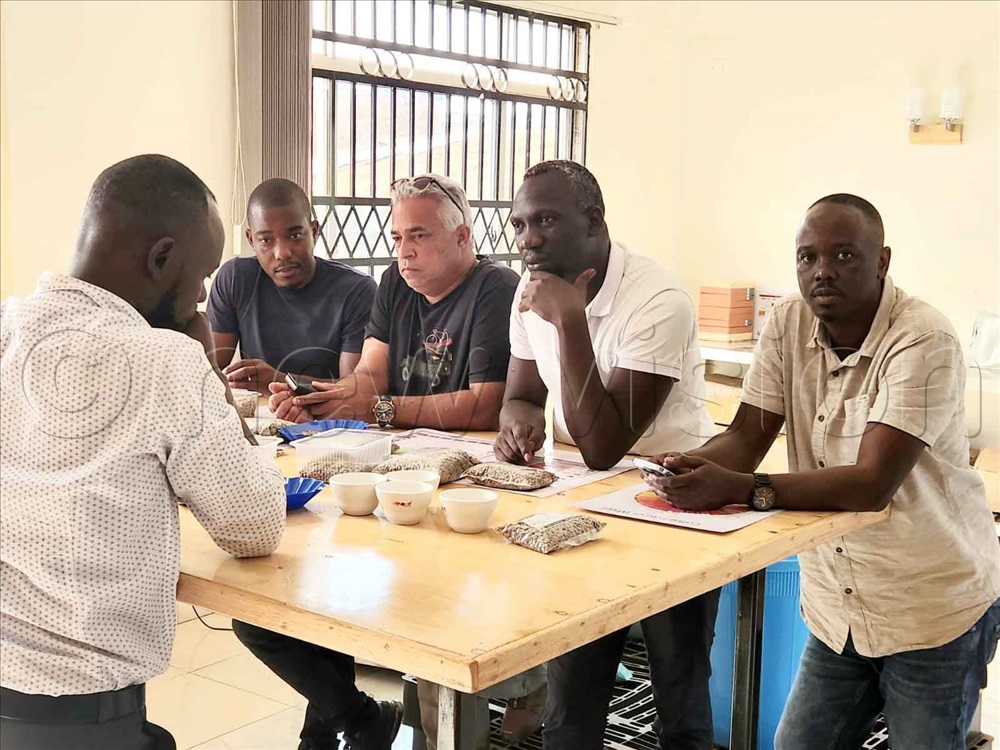
A section of Ugandans living and running their businesses in the Southern African circuit have identified a new and lucrative market for Ugandan coffee that will see the East African countries, specifically Uganda, export hundreds of tonnes, a major landmark in promoting economic development.
After discovering that South Africa is the second largest consumer of coffee and importer in Africa, the Ugandan diasporas under their umbrella body COUSA – Confederation of Ugandans living in Southern Africa, say this is an opportunity for Uganda to expand her market for coffee, exporting both green and roasted Coffee.
Moses Kibombo Ssentongo, the President of COUSA, has revealed that as a Confederation, they have written to the government with a South African Market Strategy detailing how Ugandan can make use of this virgin market to boost its coffee export in more than 100 hundred tons worth over sh1.8 billion, and this is exclusive to South Africa alone, but the figure can even triple with exports to other neighbouring countries such as Lesotho, Swaziland, Zimbabwe, Mozambique, Namibia, and Malawi.
“We’re talking about a larger quantity, tonnes and tonnes of coffee. We can import more than a hundred tons quarterly, because the buyers are there, the consumers are there, and the Ugandan Coffee is one of the best and most sought-after, especially the washed Robusta,” said Kibombo.
With the fluctuating market prices for coffee, the diaspora farmers and traders say the growth of the virgin expansive Southern Africa market comes at the right time, first, to see Uganda export value-added coffee, secondly, to export more tonnes quarterly, and other opportunities such as labour export to work in these coffee hubs.
But to achieve this, Kibombo says government has to intervene and get rid of current bottlenecks and non-tariff trade barriers hindering the exportation of roasted Ugandan coffee to the Southern African market.
“Breaking into the South African market, therefore, requires local presence and local roasting (on-ground value addition) to some extent,’ he says.
“We ask the government to step in and help us harmonise with the South African counterpart to allow us to export processed coffee that is of high value because currently they prefer green beans.”
Kibombo emphasised that they have previously written to PACEID (Presidential Advisory Committee on Exports and Industrial Development), headed by Odrek Rwabwogo, on these and more trade barriers, but they are yet to give us feedback.
Julius Muwonge, the Operations Director at Ladha Ya Africa, a South African firm that is partnering with Velvet Café Ltd to realise this dream for Uganda, says selling processed coffee to the outside market has a chance to boost Uganda’s export value to a worth more than $ 6 billion in income inflow.
“By increasing the sustainable sale of finished goods to Southern Africa, Uganda makes advances towards its target of accruing an additional $6bn from exports. This, in turn, secures farmers’ livelihoods and several jobs in the motherland,” he says.
“The hub will also give us an opportunity to control our own narrative, for our goods, their quality and their producers.”
Muwonge adds that the coffee market in South Africa is expected to see further growth, driven by both local and international influences, and that the instant coffee sector, in particular, is projected to grow by 8.24% from 2024 to 2028. This, he says, is such a great opportunity for Uganda to exploit this market and increase the cash flow for our coffee.
He further explained that through a proposed partnership with the government, the two entities (Velvet and Ladha Ya Africa) intend to set up a coffee trade hub in South Africa to facilitate the distribution of Ugandan coffee to a wider market.
“The hub will be supported by two facilities, a warehouse (back-end) and a showroom (front-end). Both these locations have been determined and appraised for suitability,” Muwonge explained, adding that the trade hub will feature a coffee shop, serving Uganda-origin goods with coffee as the anchor.
This plan, according to Muwonge, requires a total sum of $226,000 (approx. sh813 million), which they seek the government to support them with on a shared partnership.

To benefit both local and diaspora Ugandans, Kibombo says they have already established partnerships with local farmers to supply them with coffee that will be locally processed here by roasting and exporting as a ready product for the Southern Africa market.
“For example, in the greater Kigezi sub-region, we intend to partner with many farmers and farmer groups whose livelihoods we aspire to improve. We also partner with many commercial farmers, coffee collectors, processors and exporters alike. Recently, we have broken into international import houses and developed a thriving relationship with importers, including in South Africa.”
He projects that with the necessary funding from government towards this trade hub, not only coffee farmers will profit, but there will also be thousands of job opportunities both at home, under Velvet Café, and in the diaspora, under Lagha Ya Africa, which is a huge contribution to Uganda’s socioeconomic development.
Farmers react
John Byamugisha, a coffee farmer in Nyabunyungu village, Kibanda parish, Kamwezi sub-county, Rukiga district, who is already working with Ladha Ya Afrika as a supplier of coffee, expressed gratitude to Kibombo and the visionary team behind the initiative of a coffee trade hub, saying that having a ready market for his coffee has increased his earnings and improved his livelihood.
“Before this initiative, selling coffee was never easy, but now with Ladha Ya Afrika providing a ready market, my income has improved, and so has the well-being of my family. I thank Kibombo and his team for this life-changing project,” said Byamugisha.
Daniel Ssembajwe, a farmer at Misanvu Village, Kibinge sub-county in Bukomansimbi District, also praised the partnership, saying it has made coffee marketing easier and more profitable.
“Through the partnership with Ladha ya Afrika, we no longer struggle to find buyers. Our coffee is not only readily sold but also processed to add value for export. This has given us greater earnings and hope for a brighter future,” he noted.
Local leaders have also welcomed the development. Musa Matovu Kigongo, James Mugema of Lukaya in Bukomansimbi district, said the initiative has elevated the coffee sector and created economic opportunities for communities within the central region, a renowned hub for Uganda’s coffee growing.
Youth are equally enthusiastic about the new opportunities. In Mbale, young farmer Michael Wanyama said Ladha Ya Afrika’s trade model has inspired many young people to take coffee farming more seriously.
“As youth, we often think farming has no future, but this partnership with Ladha Ya Afrika has proved us wrong. With a ready market and value addition for export, coffee farming is now a viable business that can sustain us and our families,” Wanyama said.
With farmers, leaders, and youth all expressing optimism, the Ladha Ya Afrika partnership is being viewed as a turning point in strengthening Uganda’s coffee sector and boosting its competitiveness on the global market.