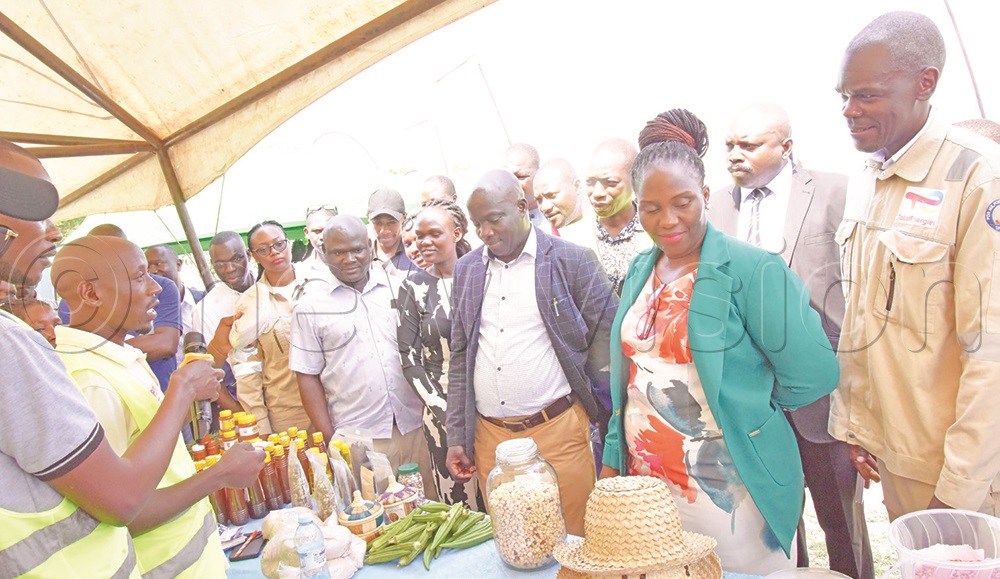
In a move to unlock the economic potential of agriculture in Uganda’s oil-rich Albertine region, TotalEnergies EP Uganda has launched the Tilenga Agribusiness Forum at the Buliisa district headquarters.
Held under the theme “Empowering Farmers and Enabling Linkages,” the forum brought together more than 200 farmer groups, value chain actors, agribusiness stakeholders, financial institutions and government representatives.
The forum is part of the company’s commitment to community transformation through its Livelihood Restoration and Community Agriculture Initiatives.
These remarks were delivered by TotalEnergies EP Uganda’s stakeholder engagement manager, Godfrey Lukwago, on behalf of the general manager Philippe Groueix.
According to Groueix’s statement, this forum is not just about farming; it’s about creating a sustainable ecosystem where local communities can thrive, innovate and lead in agricultural excellence.
‘‘By supporting linkages between farmers and agribusiness stakeholders, we are cultivating both productivity and resilience,” read the statement.
The event highlighted opportunities for farmers and Project Affected Persons (PAPs), demonstrating how agriculture can be linked to various sectors such as oil and gas, tourism, manufacturing, trade and services to improve livelihoods.
The forum also helped bridge knowledge and market gaps, offering a platform for networking, skills exchange and entrepreneurial mindset development.
The attendees were also presented with opportunities that could elevate their livelihoods. One of these opportunities was supplying agricultural produce to the oil and gas sector.
Genesis
In August 2022, the Global Livelihood Restoration programme for Resettlement Action Plan 1 (RAP 1) was launched, with the intention of distributing vocational training and start up kits to PAPs in Buliisa.
It began in March 2022 and ran until March 2025 in the districts of Buliisa, Hoima and Kikuube. The provision of Agricultural Support Services (AgriSSP) project under RAP 2–5 targeted 4,901 PAPs, representing approximately 3,990 households.
Whereas for RAP1, livelihood interventions around 104 individuals from various vocational trades such as mechanics, hairdressers, plumbers, tailors, received start up kits after training.
Lukwago revealed that these initiatives have already impacted more than 10,000 households across Buliisa, Hoima, Nwoya, Pakwach, and Kikuube, through the provision of improved seed, livestock breeds, training and increased access to markets.
Through the programme, more than 20,000 bags of cassava cuttings, 25,000 kilogrammes of maize seed, and improved livestock breeds already distributed through TotalEnergies’ support programmes.
Why the forum?
Reflecting on the forum’s purpose, Peninnah Ahebwa, the director for technical support services at the Petroleum Authority of Uganda, remarked that it responded to gaps identified by farmers and stakeholders.
These included lack of market information, limited knowledge on quality standards and the absence of group dynamics.
She praised the Albertine sub[1]region for diversifying its focus, pointing out that communities are now looking beyond oil and gas to agriculture as a natural endowment and economic driver in its own right.
The forum also featured insights from Wyclif Katurinde, the Buliisa district production officer, who highlighted some of the priority agriculture enterprises that can improve household incomes.
These include growing of crops such as cassava, pumpkins, soya beans, groundnuts, bananas, coffee, oranges, watermelon, bee and animal keeping among others.
He spoke about agribusiness value chains as an emerging area of opportunity.
He explained that the oil boom has spurred investment in non-oil sectors, such as food processing, packaging, logistics and distribution.
These industries require a consistent supply of high-quality raw materials, allowing for farmers to participate in the value chain. Part of the oil sector developments include improved infrastructure such as roads, electricity and mobile connectivity.
These improvements have reduced logistical and communication barriers, allowing farmers to expand their market reach to urban centres like Hoima and Kampala.
Thus, Ahebwa called on the farming community to explore digital agriculture platforms for access to real-time market prices and sales tools for example mobile money and digital payment systems to enable safe and efficient transactions for buying and selling agricultural products, which can further enhance profitability and efficiency.
Lukwago also highlighted the company’s ongoing efforts under its Livelihood Restoration and Corporate Social Responsibility programmes.
These initiatives aim to cushion farmers from the economic displacement that often accompanies major infrastructure projects.
They include the distribution of improved seeds and livestock, the establishment of demonstration farms, the provision of start-up kits for agri-enterprises, and support for market linkages. Lukwago noted that these efforts not only provide immediate relief but also lay the foundation for long-term income diversification and agricultural resilience.
Market for farmers’ produce
Ahebwa said oil companies and their subcontractors require consistent deliveries of fresh produce, including meat, dairy products, cereals and vegetables for their camps and operational sites.
She gave an example of Mineral Services Limited which provides catering services to over 1,200 workers in the Tilenga project camps.
Ahebwa encouraged the farmers to improve the quality of their products to benefit from this demand. Farmers were also advised to take part in Uganda’s local content initiatives by joining training programmes that prepare them for ISO-certified food production or export-readiness.
Ahebwa advised that these capacity-building efforts not only improve quality, but also enable access to both domestic and regional markets.
Farmers were encouraged to think beyond subsistence and position themselves for opportunities in the structured agribusiness economy.
Environmental conservation
Participants were encouraged to explore opportunities emerging in environmental conservation and green jobs.
Henry Kasambeko, one of the stakeholders behind the support offered to farmers in the areas of improving their agronomical skills, said there is increasing demand for services such as tree planting, nursery management, soil and water conservation and the production and supply of organic fertilisers and bio-pesticides.
These activities not only contribute to sustainability, but also present income-generating avenues for farmers and the youth.
Value addition
One of the forum’s broader objectives was to accelerate the shift from subsistence farming to agribusiness.
Thus, Benjamin Aijuka, the programmes manager at the East African Grain Council (EAGC) encouraged farmers to form groups or cooperatives to strengthen their bargaining power and fulfil bulk demands from processors involved in maize milling, cassava starch production and fruit drying.
Farmer groups were introduced to demonstration farms, post-harvest handling techniques, and digital tools to expand their reach and efficiency.
Many attendees, especially PAPs and communities from the Tilenga, welcomed the opportunity to engage with buyers and development institutions.
The forum was organised in collaboration with the EAGC, Community Integrated Development Initiative, Living Earth Uganda, and the Private Sector Foundation Uganda.
These organisations, with financial institutions, processors, and aggregators, provided guidance on value addition, financing, and market entry strategies.
Leaders have their take
Leaders present welcomed the support. Denis Isingoma, the deputy resident district commissioner of Buliisa, called on farmers to integrate government programmes like the Parish Development Model into their ventures, saying they can serve as additional catalysts for economic transformation.
Fred Lukumu, the Buliisa district chairperson, urged TotalEnergies to also invest in agricultural extension services.
“We would like these farmers to be equipped with better knowledge on modern farming techniques so that they do not only depend on oil and gas,” he said.
Benjamin Aijuka, the programmes manager at the East African Grain Council, emphasised the importance of meeting quality standards.
He said strengthening production quality at the farm level is not just a requirement for local buyers but a gateway to regional trade.
Financial support
Financial inclusion and access to capital were other areas discussed at the forum.
Joseph Bemba, the deputy country director at SASAKAWA and Samuel Bwete, the branch manager of Centenary Bank in Buliisa, urged farmers to take advantage of financial services that are increasingly being offered in partnership with the oil sector.
These include agricultural loans, input financing, and insurance products designed to support farmers in scaling up operations.
Bwete also pointed out the growing relevance of digital platforms such as mobile banking and agri-wallets in facilitating secure and transparent transactions.