Gone are the days when farmers used to randomly plant crops in the soil, hoping for a bountiful harvest, only to be disappointed.
However, with the use of modern technology, a farmer can now predict crop yields and the harvest is usually as estimated.
This was revealed during the second annual Information and Communication Technology (ICT) national summit on July 17-18.
The event was organised by the Information Communication Technology Association of Uganda and the Ministry of ICT and National Guidance at Nakawa, Kampala.
The ICT ministry’s permanent secretary, Dr Aminah Zawedde, explained that the summit aligned with the fourth national developmental plan (2025- 2030).
The summit, she explained, promotes digital transformation to leverage the use of ICT in job creation, service delivery and economic diversification.
“You might also be aware that two years ago, to implement the national priorities in the digital transformation space, a road map was developed with six particulars. These include connectivity, infrastructure, digital services, skills development, innovation and cybre security, which is drawn from the digital Uganda vision linked to the country’s digital development,” Dr Zawedde said.
“As we enter the third year of the national road map, we are planning to have 90% connectivity of the Internet districts by 2026 and this plan is in progress.”
Economy
At the centre of this digital transformation is agriculture, the backbone of the country’s economy.
Moses Nyabila, the chief executive officer of aBi Development Limited, said agriculture contributes 24% of Uganda’s Gross Domestic Product annually, which translates to sh36 trillion.
The country exports sh8 trillion in the agricultural sector annually, while its digital platforms contribute sh1 trillion in lending.
However, only 35% of 80% of Uganda’s arable land is under cultivation, and the value of unused land is estimated at $20b-$30b in potential, he added.
With the use of fast-hand technology, even the remaining land can be cultivated and the country earns income.
Increase in yields
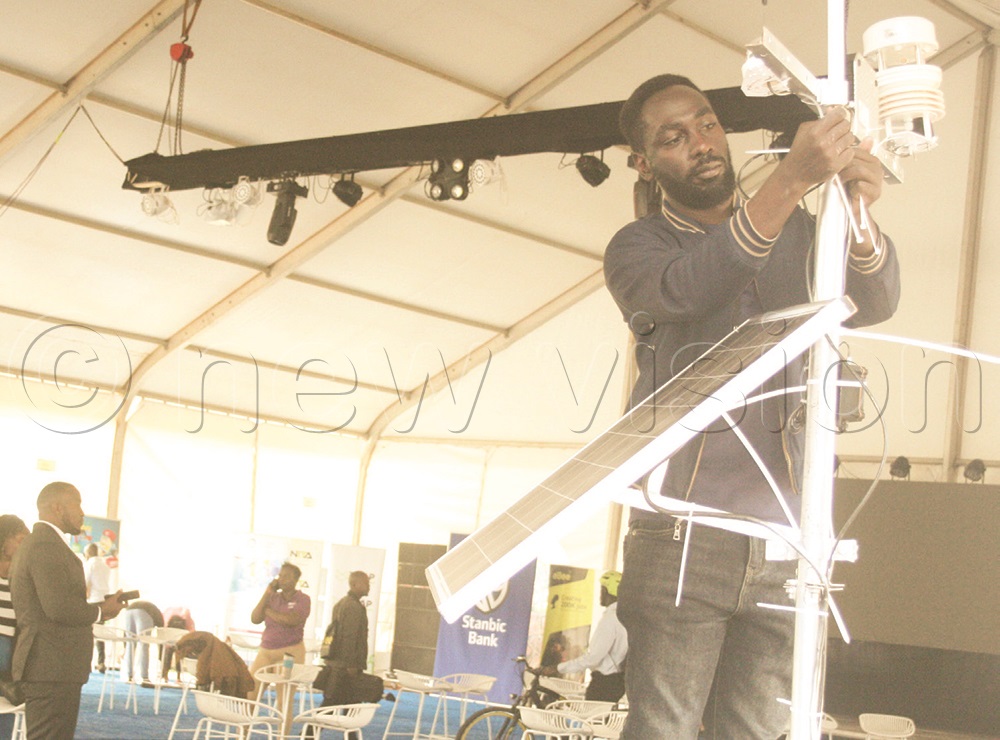
Ken Stober, the managing director of Simplifi Networks, revealed modern technology can increase farmers’ yields and also the amount of land cultivated.
When farmers know what they are doing, and also the machines used, this makes farming less cumbersome.
“When you can tell the amount of moisture in the soil or its temperature, you are able to either plant your crops or use external methods of irrigation to help you execute your plans,” Stober says.
This is possible through LoRaWAN: A low power, wide area (LPWA), Stober explains.
LoRaWAN is a networking protocol designed to wirelessly connect battery-operated things to the Internet. It is suitable for transmitting small-sized data, such as sensor data, over long distances.
The LoRaWAN’s rain gauge has an antenna that communicates back with the gateway and it gets updated every 20 minutes. This can measure the amount of rain collected in a certain area.
“The live monitor server has unlimited different sensors which can pick up timely information,” he says.
This enables you to download the data and interpret it for any purposes you want, Stober says you can study past and present, and then be able to predict the future.”
It uses low power, and Stober contends that its sensors can last up to three years on a single battery.
Connecting to banks
Aside from collecting data in the field, digital technology can also be used for other purposes.
Carol Kyazze Kakozza of Axiom Zorn Technologies, specifically the Digital Agricultural Reference Bureau, has enabled farmers to connect to banks and vice versa, as well as the market. This has been done through the collection of data from farmers.
“We have data of 686,000 farmers all over Uganda except Karamoja,” she says.
With access to information about their land and yields, and, therefore, banks cannot.
Currently, Kakozza revealed that they are unable to reach Karamoja because of funding constraints.
However, she appealed to the guests for sponsorship in such an area. For greater progress to be registered in agriculture, farmers need to formalise their operations.
Joseph Lutwama, the director programmes – Financial Sector Deepening (FSD) Uganda, said this requires vendors opening upbank accounts and the banks giving them contracts for their services.
When the vendors’ information is available online and what they can offer, working with them on the digital market becomes simpler because they can easily be accessed virtually.
“When we are discussing the topic of ICT, emphasis is usually put on communication technologies. There is more focus on the technology than information. Information is equally important as technology. Information is the backbone of any society — it shapes both economic and social relations,” he observed.
“So, with adequate information, there is value attached to it, thus the creation of digital markets. The reason, for example, that I go to the market is because someone is producing something valuable to me. This calls for value creation.”
Information wealth
Lutwama further emphasised that the information will sustain these solutions. When the information accumulates into knowledge, then innovation emerges and that is creativity.
“Any investor will look at how much value the gadget will create in sustaining the economy.”
Most importantly, Lutwama said value creation ensures that businesses get finance.
Lutwama said having a great digital solution that cannot exchange value on the digital market is useless.
He emphasised that it is important for Ugandans to develop digital solutions for thriving markets. As those markets develop in every area, including agriculture, education and finance, the pie will increase and everyone will benefit.
Long way to go
Dr Monica Musenero Masanza, the Minister of Science, Technology and Innovation, emphasised that although Uganda was taking great strides in digital access and infrastructure, the country still has a long way to go in terms of economic transformation.
She said the studies show the number of people accessing online, however, nothing is mentioned about the local value being created, owned, or retained in the process.
For the country to benefit from ICT, Musenero said there was a need to move from a consumer-centred model and focus on a more production-oriented, sovereignty-driven and value-retaining digital economy.
Other guests at the summit included Ambrose Ruyooka, the head of research and development ICT ministry, World Bank consultant Dr Drake Mirembe, head of strategy and performance – National Social Security Fund Alex Rumanyika Kalimugogo and assistant professor and manager digital trade integration project – European University Institute Dr Martina Ferracane.
LEAD PHOTO CAPTION: Ambrose Ahurra, a support engineer at Simplifi Networks, installing gateway to collect the sensor data in a farm. Modern technology can increase farmers’ yields. (Photo by Maureen Nakatudde)