For the tenth year running, Vision Group, together with the Embassy of the Netherlands, KLM Airlines, dfcu Bank and Koudijs Animal Nutrition, is running the Best Farmers Competition.
The 2025 competition runs from April to November, with the awards in December.
Every week, Vision Group platforms will publish profiles of the farmers. Winners will walk away with sh150m and a fully paid-for trip to the Netherlands.
From a wedding gift in 1990 to a multimillion-shilling enterprise, Juliet Nagaba has transformed a single cow into a thriving farming empire.
Nestled in the hills of Sheema municipality, her 35-acre Nagaba Dairy Farm is a beacon of agricultural innovation, producing milk, yoghurt, bananas, coffee, silk, and livestock, and generating over sh400m annually.
With grit, vision and a passion for agriculture, Nagaba is not only changing her own life, but also inspiring a new generation of farmers across the region Located in Kyabandara Cell, Sheema central division, Sheema municipality, Nagaba’s enterprise spans six acres of bananas, 10 acres of silk, five acres of coffee, goats, pigs, and a well-established dairy unit.
Her business is registered with the Uganda Registration Services Bureau.
Nagaba’s passion for farming was instilled by her parents, Eric and Doreka Kaganizo, now deceased, who were both crop and livestock farmers.
Her commitment was further fuelled by her husband, Isaac Nagaba, now deceased, a fellow farming enthusiast.
From one cow
Nagaba began her dairy journey with a single cross breed cow. With the support of her late husband, she reinvested earnings and gradually grew her herd to 14 friesians, producing 157 litres of milk daily.
“Passion and love are key pillars for success in farming. A cow will give you good litres of milk depending on how it is fed,” she says.

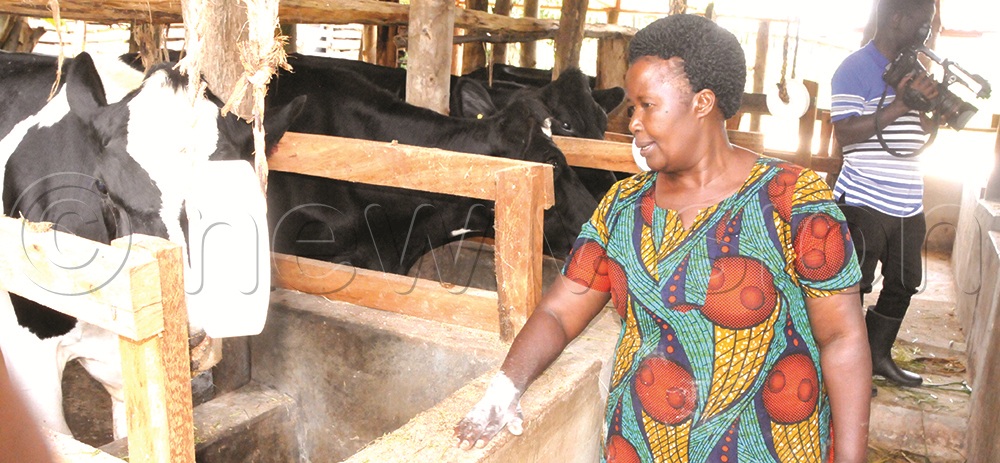
generating over sh400m annually. (Photos by Abdulkarim Ssengendo)
Her breakthrough came in 2016, when she transitioned from free-range farming to semi-zero grazing — a more structured and commercial approach. She was inspired by the Presidential Four-Acre Model, which she learned about through radio and public rallies.
“This model works for both the rich and poor. Even farmers with limited land can benefit,” she adds.
Best agronomic practices
Nagaba prioritises nutrition and animal health, believing that proper feeding is the foundation of a productive dairy cow.
“Balanced diets give cows strong immunity and high yields.”
Her cows consume 35kg– 40kg of feed daily, including improved pasture, salt licks, and silage during dry seasons.
She grows elephant grass, sugar napier, Chloris gayana, and calliandra on four acres, investing sh2m to ensure a year-round supply.
Starting with a manual pasture-cutting machine, she has since upgraded to an engine-powered one. To preserve feed quality, salt licks and silage are stored in well-maintained facilities.
Cleanliness is also paramount — from the compound to the milking areas. Her yoghurt production unit requires strict hygiene: hand-washing, gumboots and a foot-bath at the entrance to prevent disease transmission.
“Proper hygiene breaks disease cycles and protects the farm from hazards,” she explains.
“It has improved milk quality, boosted market demand and ensured safer food for customers.”
Value addition
Nagaba learned yoghurt processing through training sessions organised by Sheema district, Repa Effect and Karera Young Traders.
In 2022, she ventured into yoghurt production, starting with sh50,000 to purchase flavours.
Using savings from milk sales, she gradually acquired the following equipment: n Four milk cans – sh2m
- Stoves – sh1.2m
- Saucepans – sh2.3m
- Deep freezer – sh1.8m She now processes 260 litres of yoghurt every five days, earning sh4,000 per litre, compared to sh1,200 for raw milk.
“Value addition tripled my income,” she says.
Market reach, employment
Nagaba’s yoghurt reaches markets beyond Sheema, supplying institutions and towns — with some customers travelling from Kampala.

She promotes her products via social media, radio and public gatherings.
The farm generates over sh400m, with net earnings of about sh200m after deducting expenses.
It employs four permanent workers (earning between sh200,000 and sh300,000 monthly) and 15 casual workers, paid per task.
She plans to establish a formal training centre for farmers and students.
Management practices
Nagaba emphasises record-keeping to track expenses and inform decisions. Clean equipment is key to maintaining quality.
“Cleanliness adds value to your products,” she advises.
She is also committed to environmental conservation — planting trees, installing a 2,000-litre rainwater harvesting system and powering the farm with both hydro and solar energy.
The premises are secured with CCTV cameras. Her leadership style fosters a family-like atmosphere, treating workers as project owners — an approach that has built loyalty and commitment.
Family involvement
Nagaba credits her family for helping sustain the farm. Her four children (aged 20–34) are actively involved. Her daughter, Lisa Ankunda, serves as the project manager.
“We cannot thank our mother enough. She taught us to treat farming as a business,” says Alvin Nuwarinda, her eldest son.
“I am grateful for the opportunity to manage the farm,” adds Ankunda.
“I have gained skills and confidence to start my own.”
Community impact
Nagaba maintains strong ties with the community. Her farm creates jobs and provides access to high-quality milk and other products.
She also offers free training to local farmers and groups. So far, 16 families have received training, and many have since started their own farming ventures.
Achievements
Nagaba’s farming success has enabled her to:
- Educate all four of her children following her husband’s death in 2007
- Expand her land holdings
- Construct rental properties in Kabwohe, Mbarara, and Kyabandara towns
Lessons learned
Nagaba reflects on her journey with humility. She once neglected timely feeding schedules, which affected milk yields. Over time, she learned that:
- Cleanliness is essential for productivity
- Quality feed directly impacts milk output and livestock health
- Time and attention to livestock are critical for long-term success
Challenges
Despite her success, she continues to face signifi ant challenges. One of the most pressing issues is tick resistance, which led to the loss of three cows last year due to tick-borne diseases.
She also reports cases of blindness in her herd, which she attributes to the presence of fake veterinary drugs in the market. Other ongoing challenges include:
- Fluctuating milk prices, which impact profitability
- Unpredictable weather, particularly during dry seasons when milk production can drop to as low as 180 litres per day
- Limited access to agricultural extension services, which she believes contributes to livestock losses among farmers who lack timely expert support
Nagaba’s advice to farmers
Juliet Nagaba encourages farmers to:
- Treat farming as a business
- Monitor livestock regularly n Invest in balanced feeding
- Seek out training and knowledge wherever possible
Plan
Nagaba’s plans to:
- Expand yoghurt production
- Increase milk output to over 500 litres per day
- Empower fellow farmers through training and mentorship programmes
However, she acknowledges that limited resources constrain her ability to offer community training on a large scale.
“Many farmers are stuck in traditional methods, which affects milk production. Value addition is the future,” she insists.
She calls on the Government and development partners to support her efforts in farmer education and value addition initiatives.