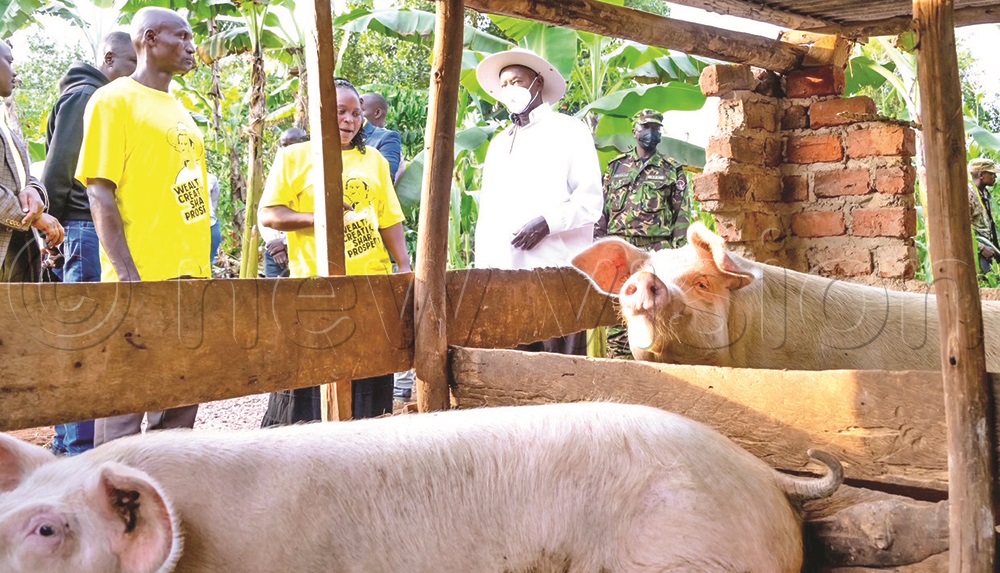
Through the Parish Development Model (PDM), the Government has so far invested sh350.3b in piggery projects, representing 13% of all enterprises funded under the programme.
An assessment of PDM performance by the Ministry of Finance, Planning and Economic Development reveals that piggery is the leading income-generating enterprise undertaken by PDM beneficiaries along the agricultural value chain.
According to the ministry’s report, over 350,000 beneficiaries are engaged in piggery projects, making it the top PDM-funded initiative promoting financial inclusion and grassroots entrepreneurship.
The ministry’s permanent secretary, Ramathan Ggoobi, described the enterprises being undertaken under PDM as transformational.
“This is a revolutionary programme that is helping people transition from a subsistence lifestyle to a money economy. You can see how effectively we are getting funds to people who never imagined they would engage in any economic activity. They are using the money in very productive ways. For example, this animal (the pig) people like eating, PDM beneficiaries have invested in sh350b,” he said.
Ggoobi, who is also the secretary to the treasury, added that the investments span various sectors, including agriculture, dairy farming, retail and small-scale manufacturing.
So far, sh3.261 trillion has been transferred directly to the accounts of PDM SACCOS across 10,594 parishes.
Of this, sh2.854 trillion, representing a national disbursement rate of 87.49%, has been given to actual beneficiaries, leaving sh407.9b still undisbursed.
Although the report does not explicitly explain why piggery is the preferred enterprise, various studies, experts, and farmers attribute this to the profitability and ease of managing pig farming.

They argue that pig farming has experienced significant growth over the past three decades, in terms of both the number of pigs reared and households involved.
According to the Uganda Bureau of Statistics Livestock Census Report (2021), the pig population increased from 3.2 million in 2008 to 7.1 million in 2021, with 2.2 million households engaged in pig rearing. Regionally, the western and central regions recorded the highest pig populations, each with about 2.3 million pigs, roughly 32% of the national herd.
Sub-regional analysis shows that Greater Masaka led with 1.2 million pigs (17.2%), followed by Buganda north (Greater Mukono and surrounding areas) with 1.1 million pigs (15%) and Bunyoro with 700,000 pigs (10.5%).
Karamoja had the lowest number at 82,000 pigs (1.2%), followed by Bukedi with 227,000 (3.2%). At the district level, Wakiso led with 426,000 pigs, followed by Mukono (231,000) and Kagadi (195,000).
Why piggery
Chris Mulindwa, a piggery business consultant, said many small-scale farmers prefer piggery due to the high demand for pork.
“A pig is easier to sell than even a chicken. Many small farmers treat pigs as their savings accounts. Whenever need arises, they can quickly sell a piglet or mature pig and solve the problem,” Mulindwa said.
He also noted that pigs offer better returns than other livestock.
“The cost of a piglet is much lower than that of a calf and a smallholder farmer does not need a large piece of land to rear pigs, especially in urban areas,” Mulindwa added.
Esther Nakajubi, a pig farmer and consultant, said with just sh1m from PDM, one can successfully rear pigs in a backyard, particularly women.
She emphasised that the market is readily available and that pigs reproduce more quickly than cattle.
“A pig can give birth twice a year, producing an average of 10 piglets each time. If one piglet sells for sh200,000, that is sh2m from just one pig’s litter. Compare that to cows, which take a year to conceive and another nine months to give birth,” she explained.
Nakajubi also noted that pigs are easy to manage, because they eat similar food with humans.
However, she warned that smallholder farmers risk heavy losses from outbreaks of African Swine Fever, a disease with no known cure.
Many farmers are unaware of how to detect or manage the disease, which could lead to devastating losses.
Jane Otai, another pig farmer, said she started with one pig in 2020 and now owns over 20 pigs of varying sizes.
“I began with one pig that gave birth to 10 piglets in six months. I sold some and raised two more, which also produced 20 piglets. The cycle has continued. I sell some and keep others. They are like my ATM; whenever I need money, I can sell one within hours. Try that with a cow,” she said.
Anon Aroho, a pig farmer from Katoke in Kyenjojo district, said he and his wife chose piggery because it required little land and attention.
“We both work, so we needed a project that would not require constant supervision. We started with three piglets, and within eight months, they had multiplied to 19. We sell some and keep others,” he shared.
Uganda is the largest pork consumer in Africa and ranks second globally, after China. The average Ugandan consumes 3.5kg of pork annually, according to the International Livestock Research Institute (ILRI).
Other enterprises
The report also highlights other top PDM investments: coffee (sh334.2b), poultry (sh325.8b), goats (sh298b), maize (sh247.9b), bananas (sh154.4b) and cattle (sh135b).
Ineligible projects
In a report to Parliament for the year ending December 2024, Auditor General Edward Akol raised concerns over misuse and mismanagement of PDM funds.
He reported that 342 beneficiaries across 253 PDM SACCOS in 50 local governments had implemented ineligible projects.
Another 170 beneficiaries in 124 SACCOS across 37 districts had non-existent projects and 1,004 beneficiaries who received sh1b failed to account for sh286m.
“These irregularities undermine the objectives of the PDM,” Akol noted.
He attributed the issues to unfavourable seasonal variations, contradictions with PDM guidelines, delays in fund disbursement and land shortages in urban areas.
Akol also observed that 26,525 crop farmers across 69 local governments received funds outside the planting season, leading to low yields or misuse of funds.
About PDM
Parish Development Model (PDM) is a Government strategy to transition 39% of households from a subsistence economy into the money economy. Launched by President Yoweri Museveni on February 26, 2022, in Kibuku district, the programme covers all parishes across Uganda.
Communities are required to form enterprise groups, which then form PDM SACCOS, one per parish. These groups are registered as Community-Based Organisations (CBOs) under the NGOs Act.
The SACCOS then apply for funding from the Parish Revolving Fund (PRF), which offers concessional loans at 6% annual interest.
Each household or enterprise is financed according to the nature of its activity and loans must be recovered within three years.
LEAD PHOTO CAPTION: Museveni inspecting Nampa Harriet’s piggery business (centre), a beneficiary of PDM in Mangaliba village, Nakisunga sub-county in Mukono district, last month. (PPU photo)