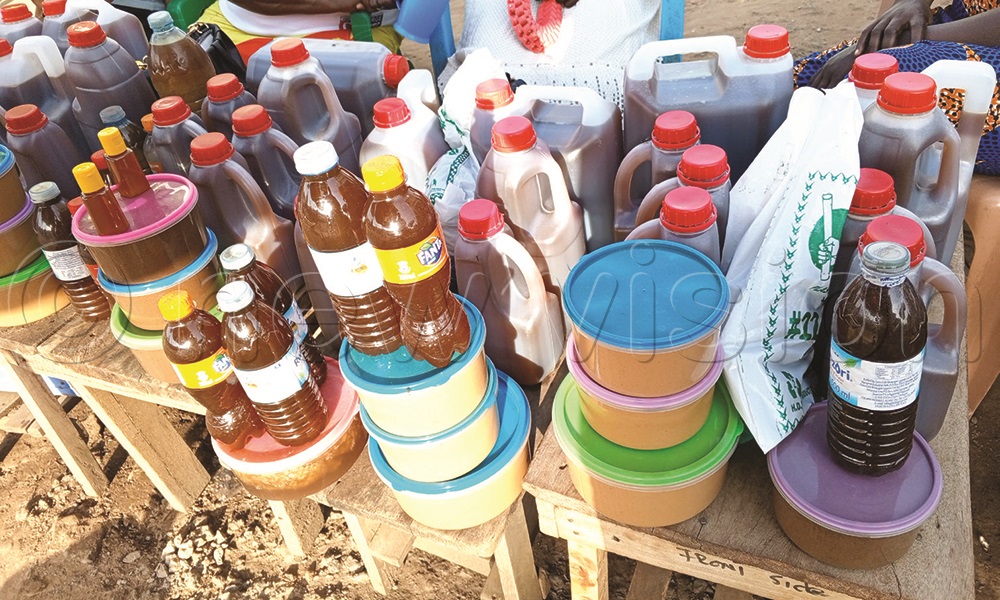
West Nile’s honey industry is thriving, with many traders capitalising on the region’s potential to produce the product.
However, the sector faces challenges, including adulteration, as some traders mix honey with molasses and other substances, threatening the industry’s reputation and livelihoods of those involved.
Alice Okunia, a resident of Robu village in Maracha district, has been trading in honey for several years. Every day, she hires a motorcycle to transport the honey for sale in Arua city.
“I buy honey from Ariwara in Democratic Republic of Congo at sh200,000 per 20-litre jerrycan and I get a profit of sh40,000,” Okunia said.
She has heard about adulterated honey and thus is cautious when buying the product, especially from DR Congo — her major source.
“When I see the honey is light, I do not buy it because it may be fake,” Okunia said.
Mary Asibazuyo, another honey vendor on Rhino camp Road in Arua city, has done this business for 25 years. She traverses West Nile and some parts of DR Congo in search of good quality honey.
Asibazuyo recalls that when she joined the business, there were a few traders selling honey in Arua city. Today, there are more traders on board, which she attributes to the lucrativeness of the business.
Production potential
West Nile and northern Uganda produce 640 tonnes per annum, making it a major honey-producing area. Nationally, Uganda produces about 200,000 tonnes of honey, according to the Ministry of Agriculture Animal Industry and Fisheries.
The ministry says the country has the potential to produce at least 500,000 tonnes per year. On the other hand, the global demand for honey is estimated at 1.8 million tonnes, with a market value of $7.8b.
Uganda’s honey production has potential to meet domestic and international demands. Several initiatives, both by the Government and the private sector, have been put in place to enable the country meet market demands.
For example, companies like Honey Pride, based in Arua and Bee Natural products are working with over 1,700 farmers in northern Uganda to improve the quantity and quality of honey they produce.

They provide guidance and skills that include how to breed bees, use proper harvesting equipment and cautioning against harmful practices, such as smoking bees during the harvesting of honey.
They also provide a reliable market, enabling farmers to produce high quantities of honey and improve their livelihoods.
Keeping honey pure
Uganda’s honey, after undergoing several tests in Britain and Germany, has been ranked as the best in Africa.
This was revealed by Horace Azabo, a trainer of trainers with ACORD, a non-governmental organisation under poverty alleviation programme among refugees and host communities in Adjumani district.
However, this standard is under threat, owing to the adulteration of honey and other risks in the value chain that affect the quality of the product.
One risk is the unregulated use of highly hazardous pesticides (HHPs) by farmers, which has contributed significantly to a reduction in the population of bees in West Nile subregion.
Both the EU and Uganda have banned numerous HHPs, due to their risks to human health and the environment. Examples include DDT, Aldrin and Lindane, which are known carcinogens or have other severe health impacts Prof. Robert Kajobe, the chairperson of the Uganda National Apiculture Development Organisation, the apex body that unites bee farmers countrywide, also an academic at Muni University, says there are acceptable limits within the quality assurance system of honey. There is no possibility that farmers can have zero traces of chemicals in honey.
While traces of agro-chemicals have been found in honey, in northern Uganda, these have not surpassed acceptable levels.
He, however, quickly adds that in south-western Uganda, where several farmers apply large quantities of acaricides and other agro-chemicals in their farmlands, there are indications that traces of chemicals in honey are rising exponentially.
Thus, the call for a stricter pesticide management. Another route through which chemicals may get into honey is the use of rudimentary methods during its extraction.
“Many people use mosquito nets to extract honey, yet they have insecticides, thus compromising the quality of honey,” Dr Kajobe said.
He thus advises farmers to use professional methods of extracting honey from the combs to produce a good quality product that meets international standards.
A second challenge in the industry is the delay in colonisation of hives, owing to a scarcity of bees. Prof. Kajobe says the number of bee colonies in Uganda is reducing, not only because of agro-chemicals, but also the destruction of natural bee habitats, owing to population explosion.
“The increasing destruction of forests in the country has led to inadequate forage in the wild, which has contributed to a reduced population of bees,” he advised.
Some of the harmful practices that experts hold responsible for a declining bee population is bush burning. It is a common practice in rural areas, which destroys the natural habitats of bees. Climate change is also contributing to a reduction in the bee population.
Ocima says owing to climate change, the weather is unpredictable and flowers no longer blossom as expected, leaving bees with few food sources.
“Harsh chemicals also kill the bees. The changing climate is not helping either. We are seeing fewer bees each year,” Ocima added.
With fewer bees, the risk is not just to honey farmers, but to crop production in general. Bees play a key role in pollination and their disappearance could lead to lower yields and increased food insecurity.
Ramadhan Aniku, a honey processor at Honey Pride in Arua city, said the reduction in bees’ population is not just affecting honey production, but also the livelihood of many families.
“If the bees die, we have no honey and that means no income for school fees or food,” Aniku stressed.
As bee numbers continue to fall, farmers in Arua are urging the public and policymakers to take action before it is too late.
A lot of attention should be paid to conserving the natural habitats to protect the bees, Kajobe advised.
“We need support and strong laws, because bees are life givers,” Aniku added.
The third challenge in the trade is poor harvest and post-harvest handling of honey due to lack of information and extension services, especially in the remote parts of DR-Congo, Kajobe said.
Traders add that farmers in DR Congo boil honey, which denatures the product, compromising its quality.
Zainabu Abulu, a honey vendor, buys the product from farmers in the West Nile sub-region (Maracha, Terego districts) and DR Congo. She accuses some suppliers from Kampala for allegedly supplying adulterated honey.
To protect their market, Abulu said traders are hypervigilant to guard against buying a fake product.
Countering adulteration
To improve the quality of honey, Azabo advises on post-harvest handling practices.
“One can sieve the honey first to get rid of contaminants like leaves, grass or insects,” he says.
Farmers and honey vendors are advised to store honey in air tight containers, saying once moisture gets into honey, it is adulterated.
“If you keep honey in airtight buckets, your honey can last for up to 200 years, unadulterated,” Azabo noted.
How to identify good honey
Charles Asiki, the former mayor of the then Arua municipality, said pure honey is sticky and does not have foam.
“As a consumer, there are two ways to test the quality of honey. Pour a bit on a table and if it spreads quickly, it is adulterated. Or if you pour honey in sand and it sinks quickly, it is also adulterated,” he explains.
Asiki, who is also a beekeeper, says greed is the reason people sell fake honey.
“Because of an unquenchable thirst for money, some unscrupulous individuals seek to increase the quantity of their honey at the expense of quality. They add all sorts of things to double the quantity for sale. Some people mix molasses (sukari guru) or other substances, which is wrong,” he says.
“Molasses may look like honey, but they are not and do not have any nutrients. The use of molasses damages the reputation of real honey producers,” warned Eric Ocima, the head of the value addition chain at Honey Pride in Arua city